1) What is Angular2?
Angular2 is a free open source component-based UI Framework from google web development team re-written in TypeScript ( Superset of JavaScript ).
2) What are the new features of Angular 2?
Angular 2 is a platform that encompasses a wide range of capabilities. Some new features were added in Angular 2 which includes:
- Universal server rendering- It is the library that is used to make building universal apps a smooth experience. It is an important feature of Angular 2.
- A mobile toolkit- It provides all mobile toolkit and techniques to build high-performance mobile applications. The web applications which are developed using the mobile toolkit can be loaded on any device with or without an internet connection which is a great advantage.
- A command-line interface-it can generate components, routes, services, and pipes with the help of commands.
- Data binding- data binding has been improved in Angular 2. So, whatever DOM element property you need to bind, you just wrap it in square brackets. E.g.-<img[src]=’product.image’ />
- Modular- various modules have been removed from angular’s core, which has resulted in better performance.
- Modern- Angular 2 has been targeted as modern browsers in which various hacks that make angular harder to develop have been removed.
3) What Are The New Features Of Angular2?
Angular 2 is written entirely in Typescript and meets the ECMAScript 6 specification :
- Component-Based- Angular 2 is entirely component-based. Controllers and $scope are no longer used. They have been replaced by components and directives.
- Directives- The specification for directives is considerably simplified, although they are still subject to change. With the @Directive annotation, a directive can be declared.
- Dependency Injection- Because of the improved dependency injection model in Angular2, there are more opportunities for component / object-based work.
- Use of TypeScript-TypeScript is a typed superset of JavaScript which has been built and maintained by Microsoft and chosen by the AngularJS team for development. The presence of types makes the code written in TypeScript less prone to run-time errors. In recent times, the support for ES6 has been greatly improved and a few features from ES7 have been added as well.
- Generics- TypeScript has generics that can be used in the frontend.
- Lambdas with TypeScript- In TypeScript, lambdas are available.
- Forms and Validations- Forms and validations are an important aspect of frontend development. Within Angular 2 the Form Builder and Control Group are defined.
4) What is the difference between AngularJS and Angular?
Angular is a completely revived component-based framework in which an application is a tree of individual components.
Some of the major difference in tabular form
| AngularJS | Angular |
|---|---|
| It is based on MVC architecture | This is based on Service/Controller |
| This uses use JavaScript to build the application | Introduced the typescript to write the application |
| Based on controllers concept | This is a component-based UI approach |
| Not a mobile-friendly framework | Developed considering mobile platform |
| Difficulty in SEO friendly application development | Ease to create SEO friendly applications |
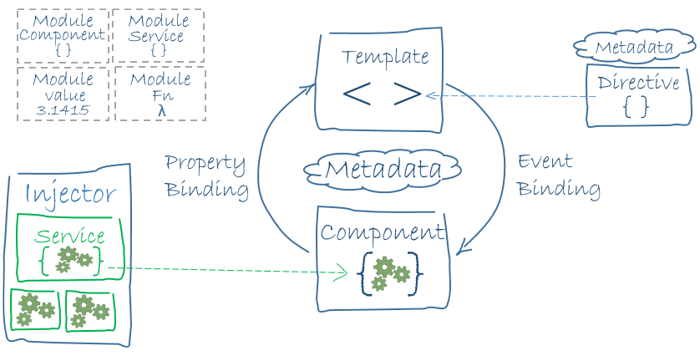
5) Write a pictorial diagram of Angular architecture?
The main building blocks of an Angular application is shown in the below diagram
6) What are the key components of Angular?
Angular has the below key components,
- Component: These are the basic building blocks of angular application to control HTML views.
- Modules: An angular module is set of angular basic building blocks like component, directives, services etc. An application is divided into logical pieces and each piece of code is called as “module” which perform a single task.
- Templates: This represent the views of an Angular application.
- Services: It is used to create components which can be shared across the entire application.
- Metadata: This can be used to add more data to an Angular class.
7) What are directives?
Directives add behavior to an existing DOM element or an existing component instance.
import { Directive, ElementRef, Input } from '@angular/core';

@Directive({ selector: '[myHighlight]' })
export class HighlightDirective {
    constructor(el: ElementRef) {
       el.nativeElement.style.backgroundColor = 'yellow';
    }
}
Now this directive extends HTML element behavior with a yellow background as below
<p myHighlight>Highlight me!</p>
8) What are components?
Components are the most basic UI building block of an Angular app which formed a tree of Angular components. These components are subset of directives. Unlike directives, components always have a template and only one component can be instantiated per an element in a template. Let’s see a simple example of Angular component
import { Component } from '@angular/core';

@Component ({
   selector: 'my-app',
   template: ` <div>
      <h1>{{title}}</h1>
      <div>Learn Angular6 with examples</div>
   </div> `,
})

export class AppComponent {
   title: string = 'Welcome to Angular world';
}
9) What are the differences between Component and Directive?
In a short note, A component(@component) is a directive-with-a-template.
Some of the major differences are mentioned in a tabular form
| Component | Directive |
|---|---|
| To register a component we use @Component meta-data annotation | To register directives we use @Directive meta-data annotation |
| Components are typically used to create UI widgets | Directive is used to add behavior to an existing DOM element |
| Component is used to break up the application into smaller components | Directive is use to design re-usable components |
| Only one component can be present per DOM element | Many directives can be used per DOM element |
| @View decorator or templateurl/template are mandatory | Directive doesn’t use View |
10) What is a template?
A template is a HTML view where you can display data by binding controls to properties of an Angular component. You can store your component’s template in one of two places. You can define it inline using the template property, or you can define the template in a separate HTML file and link to it in the component metadata using the @Component decorator’s templateUrl property. Using inline template with template syntax,
import { Component } from '@angular/core';

@Component ({
   selector: 'my-app',
   template: '
      <div>
         <h1>{{title}}</h1>
         <div>Learn Angular</div>
      </div>
   '
})

export class AppComponent {
   title: string = 'Hello World';
}
Using separate template file such as app.component.html
import { Component } from '@angular/core';

@Component ({
   selector: 'my-app',
   templateUrl: 'app/app.component.html'
})

export class AppComponent {
   title: string = 'Hello World';
}
11) What is a module?
Modules are logical boundaries in your application and the application is divided into separate modules to separate the functionality of your application. Lets take an example of app.module.ts root module declared with @NgModule decorator as below,
import { NgModule }      from '@angular/core';
import { BrowserModule } from '@angular/platform-browser';
import { AppComponent }  from './app.component';

@NgModule ({
   imports:      [ BrowserModule ],
   declarations: [ AppComponent ],
   bootstrap:    [ AppComponent ]
})
export class AppModule { }
The NgModule decorator has three options
- The imports option is used to import other dependent modules. The BrowserModule is required by default for any web based angular application
- The declarations option is used to define components in the respective module
- The bootstrap option tells Angular which Component to bootstrap in the application
12) What are lifecycle hooks available?
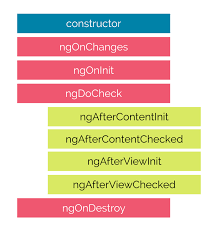
Angular application goes through an entire set of processes or has a lifecycle right from its initiation to the end of the application. The representation of lifecycle in pictorial representation as follows,
The description of each lifecycle method is as below,
- ngOnChanges: When the value of a data bound property changes, then this method is called.
- ngOnInit: This is called whenever the initialization of the directive/component after Angular first displays the data-bound properties happens.
- ngDoCheck: This is for the detection and to act on changes that Angular can’t or won’t detect on its own.
- ngAfterContentInit: This is called in response after Angular projects external content into the component’s view.
- ngAfterContentChecked: This is called in response after Angular checks the content projected into the component.
- ngAfterViewInit: This is called in response after Angular initializes the component’s views and child views.
- ngAfterViewChecked: This is called in response after Angular checks the component’s views and child views.
- ngOnDestroy: This is the cleanup phase just before Angular destroys the directive/component.
13) What is a data binding?
Data binding is a core concept in Angular and allows to define communication between a component and the DOM, making it very easy to define interactive applications without worrying about pushing and pulling data. There are four forms of data binding(divided as 3 categories) which differ in the way the data is flowing.
- From the Component to the DOM: Interpolation: {{ value }}: Adds the value of a property from the component
<li>Name: {{ user.name }}</li>
<li>Address: {{ user.address }}</li>
Property binding: [property]=”value”: The value is passed from the component to the specified property or simple HTML attribute
<input type="email" [value]="user.email">
- From the DOM to the Component: Event binding: (event)=”function”: When a specific DOM event happens (eg.: click, change, keyup), call the specified method in the component
<button (click)="logout()"></button>
- Two-way binding: Two-way data binding: [(ngModel)]=”value”: Two-way data binding allows to have the data flow both ways. For example, in the below code snippet, both the email DOM input and component email property are in sync
<input type="email" [(ngModel)]="user.email">
14) What is metadata?
Metadata is used to decorate a class so that it can configure the expected behavior of the class. The metadata is represented by decorators
- Class decorators, e.g. @Component and @NgModule
import { NgModule, Component } from '@angular/core';

@Component({
  selector: 'my-component',
  template: '<div>Class decorator</div>',
})
export class MyComponent {
  constructor() {
    console.log('Hey I am a component!');
  }
}

@NgModule({
  imports: [],
  declarations: [],
})
export class MyModule {
  constructor() {
    console.log('Hey I am a module!');
  }
}
- Property decorators Used for properties inside classes, e.g. @Input and @Output
import { Component, Input } from '@angular/core';

@Component({
    selector: 'my-component',
    template: '<div>Property decorator</div>'
})

export class MyComponent {
    @Input()
    title: string;
}
- Method decorators Used for methods inside classes, e.g. @HostListener
import { Component, HostListener } from '@angular/core';

@Component({
    selector: 'my-component',
    template: '<div>Method decorator</div>'
})
export class MyComponent {
    @HostListener('click', ['$event'])
    onHostClick(event: Event) {
        // clicked, `event` available
    }
}
- Parameter decorators Used for parameters inside class constructors, e.g. @Inject
import { Component, Inject } from '@angular/core';
import { MyService } from './my-service';

@Component({
    selector: 'my-component',
    template: '<div>Parameter decorator</div>'
})
export class MyComponent {
    constructor(@Inject(MyService) myService) {
        console.log(myService); // MyService
    }
}
15) What is the difference between constructor and ngOnInit?
TypeScript classes has a default method called constructor which is normally used for the initialization purpose. Whereas ngOnInit method is specific to Angular, especially used to define Angular bindings. Even though constructor getting called first, it is preferred to move all of your Angular bindings to ngOnInit method. In order to use ngOnInit, you need to implement OnInit interface as below,
export class App implements OnInit{
  constructor(){
     //called first time before the ngOnInit()
  }

  ngOnInit(){
     //called after the constructor and called  after the first ngOnChanges()
  }
}
16) What is a service?
A service is used when a common functionality needs to be provided to various modules. Services allow for greater separation of concerns for your application and better modularity by allowing you to extract common functionality out of components. Let’s create a repoService which can be used across components,
import { Injectable } from '@angular/core';
import { Http } from '@angular/http';

@Injectable({ // The Injectable decorator is required for dependency injection to work
  // providedIn option registers the service with a specific NgModule
  providedIn: 'root',  // This declares the service with the root app (AppModule)
})
export class RepoService{
  constructor(private http: Http){
  }

  fetchAll(){
    return this.http.get('https://api.github.com/repositories');
  }
}
The above service uses Http service as a dependency.
17) What is dependency injection in Angular?
Dependency injection (DI), is an important application design pattern in which a class asks for dependencies from external sources rather than creating them itself. Angular comes with its own dependency injection framework for resolving dependencies( services or objects that a class needs to perform its function). So you can have your services depend on other services throughout your application.
18) What is the purpose of async pipe?
The AsyncPipe subscribes to an observable or promise and returns the latest value it has emitted. When a new value is emitted, the pipe marks the component to be checked for changes. Let’s take a time observable which continuously updates the view for every 2 seconds with the current time.
@Component({
  selector: 'async-observable-pipe',
  template: `<div><code>observable|async</code>:
       Time: {{ time | async }}</div>`
})
export class AsyncObservablePipeComponent {
  time = new Observable(observer =>
    setInterval(() => observer.next(new Date().toString()), 2000)
  );
}
19) What is the purpose of ngFor directive?
We use Angular ngFor directive in the template to display each item in the list. For example, here we iterate over list of users,
<li *ngFor="let user of users">
  {{ user }}
</li>
The user variable in the ngFor double-quoted instruction is a template input variable
20) What is interpolation?
Interpolation is a special syntax that Angular converts into property binding. It’s a convenient alternative to property binding. It is represented by double curly braces({{}}). The text between the braces is often the name of a component property. Angular replaces that name with the string value of the corresponding component property. Let’s take an example,
<h3>
  {{title}}
  <img src="{{url}}" style="height:30px">
</h3>
In the example above, Angular evaluates the title and url properties and fills in the blanks, first displaying a bold application title and then a URL.
21) How do you categorize data binding types?
Binding types can be grouped into three categories distinguished by the direction of data flow. They are listed as below,
- From the source-to-view
- From view-to-source
- View-to-source-to-view
The possible binding syntax can be tabularized as below,
| Data direction | Syntax | Type |
|---|---|---|
| From the source-to-view(One-way) | 1. {{expression}} 2. [target]=”expression” 3. bind-target=”expression” | Interpolation, Property, Attribute, Class, Style |
| From view-to-source(One-way) | 1. (target)=”statement” 2. on-target=”statement” | Event |
| View-to-source-to-view(Two-way) | 1. [(target)]=”expression” 2. bindon-target=”expression” | Two-way |